
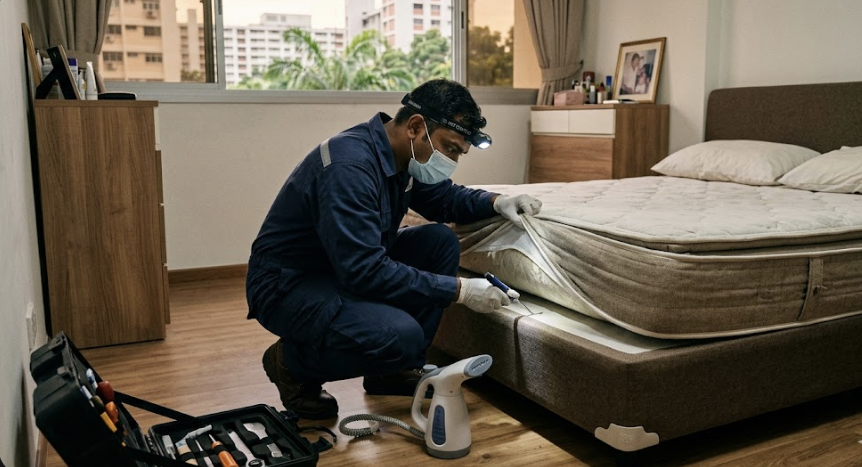
Waking up with red, itchy welts arranged in a cluster of three — the classic “breakfast, lunch, and dinner” bite pattern — is one of the most unsettling discoveries a Singapore homeowner can make.
Bed bugs are not a sign of poor hygiene. They do not discriminate between a cluttered warehouse and a spotless Orchard Road condominium. They hitchhike, hide, and breed in silence — and by the time most people notice them, the infestation is already well established.
This is your complete reference guide to understanding, identifying, and eradicating bed bugs in Singapore.
What Are Bed Bugs?
Cimex lectularius — the common bed bug — is a small, flat, reddish-brown insect roughly the size of an apple seed when fully grown. Nymphs (juveniles) are nearly translucent, making them exceptionally difficult to spot with the naked eye.
They feed exclusively on blood, typically emerging at night when carbon dioxide from a sleeping host signals that their meal has arrived. A single female can lay up to five eggs per day and up to 500 over her lifetime — which is why a small, early-stage infestation can become a severe one within weeks.
They do not transmit disease, but their psychological impact — the inability to sleep in your own bed without anxiety — is a very real cost.
How to Tell If You Have Bed Bugs
The bites alone are not a reliable indicator. Bed bug bites are clinically indistinguishable from mosquito bites, heat rash, or reactions to other insects. Do not base your conclusion on skin reactions alone — look for physical evidence.
Physical signs to look for:
- Blood spots on bedding — small rust-coloured smears left when a fed bug is accidentally rolled over during sleep
- Dark faecal spots — tiny black or dark brown specks about the size of a pen dot; look along mattress seams, headboards, and skirting boards
- Shed skins (exuviae) — bed bugs moult five times as they mature; these translucent husks accumulate in harbourage areas
- Live bugs — flat, oval, and reddish-brown; found in mattress seams, inside timber bed frame joints, behind headboards, along skirting boards, and inside wall sockets on shared walls
- A sweet, musty odour — large infestations produce a faint, distinctive scent from the bugs’ scent glands; an unexplained smell of overripe fruit in your bedroom is worth investigating
Where to inspect first:
Bed bugs follow one rule — stay as close to their food source as possible. Begin with the mattress seams and box spring, then move to the bed frame. In a mature infestation they spread outward: sofas, curtain hems, loose wallpaper edges, electrical conduits, picture frames, and eventually into wall cavities.
If you are only finding bites and no physical evidence, a professional thermal imaging inspection can locate harbourage points that are invisible during a manual check.
How Bed Bugs Get Into Your Home
The most persistent myth about bed bugs is that they come from dirty homes. They do not. They travel with people and objects — and Singapore’s lifestyle makes exposure routine for most residents.
The most common introduction routes:
- Travel — hotel rooms, serviced apartments, Airbnbs, and even business class airline seats are frequent sources. Bugs or their eggs attach to luggage, clothing, and bags without being seen. A single stay in an infested room is enough
- Second-hand furniture — upholstered sofas, mattresses, and timber bed frames bought from Carousell, flea markets, or bulk waste disposal areas carry significant risk, even if they appear clean. Eggs inside joints and seams are invisible without a torch and a trained eye
- Visitors’ belongings — a guest’s overnight bag left on your sofa or bedroom floor for a few hours can introduce bugs from their own infested home
- Shared laundry facilities — common laundry rooms in condominiums are a less-discussed but real vector, particularly when folded clothing is placed on shared surfaces between cycles
Cross-unit transmission in HDB flats and condominiums:
This is the scenario most residents do not anticipate. If a neighbouring unit has an active infestation, a clean home offers limited protection on its own. Bed bugs travel through shared electrical conduits, bathroom and kitchen pipe chases, hairline cracks in shared walls, and under main doors along the common corridor. Older estates — Toa Payoh, Queenstown, Ang Mo Kio — are particularly susceptible due to ageing infrastructure, but newer BTOs are not immune.
→ Read our in-depth guide: Neighbour’s Bedbugs Are Coming Through the Wall — How to Defend Your HDB Unit Now
That article covers exactly how to physically seal your unit against cross-unit migration, what your Town Council can and cannot do, and the point at which sealing stops being enough.
DIY vs. Professional Treatment: Why Consumer Sprays Fail
Walk into any supermarket or hardware shop in Singapore and you will find aerosol sprays, foggers, and products marketed as bed bug solutions. The problem is not that these products do nothing — it is what they fundamentally cannot reach.
The structural limits of off-the-shelf products:
- Eggs are chemically resistant. Most consumer insecticides have no ovicidal (egg-killing) effect. Even if every live bug in a room is knocked back, the eggs continue developing and the infestation resets within two weeks
- Harboured bugs are unreachable. Bed bugs spend the vast majority of their time deep inside mattress seams, timber joints, wall cavities, and the hollow legs of metal bed frames — places where surface sprays make no contact
- Foggers disperse bugs without eliminating them. The pressure and scent of a fogging bomb causes bed bugs to scatter deeper into harbourage points and — critically — into adjacent rooms or units, spreading the infestation further
Consumer sprays suppress surface activity temporarily. They do not break the breeding cycle.
What professional treatment does differently:
Ezzy Pest Management’s NEA-certified technicians use an Integrated Pest Management (IPM) approach — identifying and treating the root source of the infestation, not just the visible surface layer.
Our treatment process includes:
- Thermal imaging inspection to locate hidden colonies inside walls, furniture, and flooring before treatment begins — eliminating guesswork
- Targeted residual insecticide treatment applied to all harbourage points: mattress seams, furniture joints, skirting board gaps, electrical conduit access points, and pipe chase entry areas
- Post-treatment monitoring to confirm that the full breeding cycle has been broken — not just the adult population
- A 2-month warranty on all treatments, with an exclusive 5% discount on professional services
- A 24-hour emergency helpline for urgent cases where you cannot wait
With over 20 years of field experience and a consistent track record reflected in our pest control Singapore reviews, Ezzy is recognised as one of the best bed bug treatment companies in Singapore. Our clients’ feedback consistently highlights two things: the rigour of our inspection process and the reliability of our after-treatment follow-through.
The true cost of waiting:
A small infestation caught early is significantly less disruptive and less expensive to treat than a mature one. Bed bugs reproduce fast. A colony that occupies one bedroom today can spread to a second bedroom, the living room sofa, and a neighbouring unit within weeks. Early professional intervention is not an overreaction — it is the economically rational decision.
If you have found physical evidence of bed bugs, do not delay. The colony is already established, and every week of inaction expands the scope and cost of treatment.
Frequently Asked Questions
Can I get rid of bed bugs myself without calling a pest control company?
Consumer aerosols and foggers are unlikely to eliminate an established bed bug infestation because they cannot penetrate the deep harbourage points where eggs are laid and most of the colony rests between feeding cycles. For a very early-stage case confined to a single item — a garment or a pillowcase — placing it in a clothes dryer on high heat for 30 minutes can be effective for that item alone. But once bugs have spread to a mattress, bed frame, or any wall cavity, professional treatment with residual insecticide is the only reliable route to full eradication. Ezzy’s 2-month warranty backs every treatment we carry out.
How long does a professional bed bug treatment take, and do I need to leave my home?
A standard Ezzy treatment for an HDB flat typically takes 2 to 4 hours, depending on flat size and infestation severity, with residents advised to vacate the treated area for 2 to 4 hours post-treatment. Our technicians will brief you on preparation steps before the appointment — including how to bag and store clothing, bedding, and personal items. Most families are able to return to their home the same evening.
Why do bed bugs keep coming back even after a treatment?
Recurrence after professional treatment almost always stems from one of three causes: an incomplete initial visit that missed a harbourage point, a new post-treatment introduction via travel or second-hand items, or ongoing migration from an untreated neighbouring unit. Ezzy’s 2-month warranty covers retreatment if activity persists — and our technicians will investigate the re-introduction route as part of the follow-up inspection, not just re-treat the symptoms.
Ezzy Pest Management | NEA-Certified | 24-Hour Helpline | 2-Month Warranty | 5% Discount on Professional Services


