
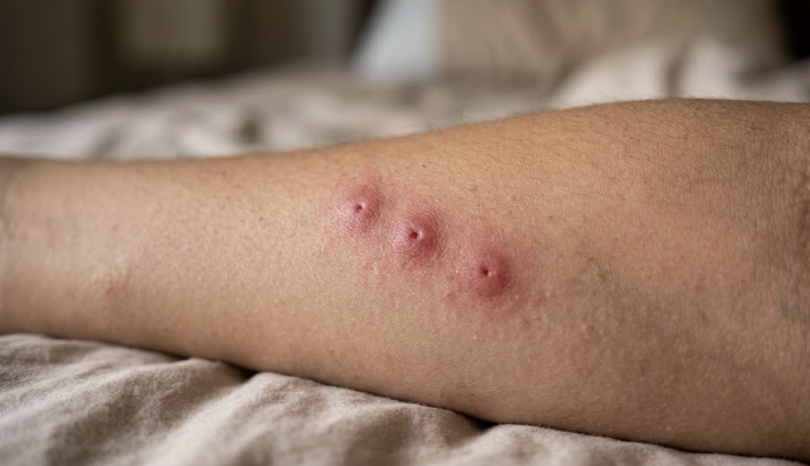
You woke up with red, itchy marks on your arm. You have no idea what caused them.
In Singapore, that question is harder to answer than it sounds. We live with mosquitoes year-round, dust mite exposure is almost universal, and sand flies appear near coastal and forested areas. Every single one of them bites — and none of them leave a business card.
This article is specifically about how to tell the bites apart. Not how to treat an infestation. Not what bed bugs look like. Just the bites — because getting this wrong costs you weeks of misdiagnosis and anxiety.
Why Singapore Makes This Genuinely Difficult
Most countries have a clear “bite season.” Singapore does not. Our tropical climate means mosquitoes are active every month of the year, and dust mite populations thrive in our warm, humid homes regardless of season.
This matters because the default assumption for most Singaporeans when they see a skin reaction is: mosquito. That assumption delays bed bug detection by weeks — sometimes months — because the bites can look nearly identical.
A dermatologist cannot reliably tell you what bit you from the bite alone. Neither can you. The skin reacts to the saliva, and many insect salivas trigger the same histamine response: red, raised, itchy.
So the bites themselves are not your primary diagnostic tool. But the pattern, location, and timing of the bites tell a much clearer story.
Bed Bug Bites vs. Mosquito Bites
This is the comparison that trips most people up.
Mosquito bites:
- Appear immediately or within minutes of being bitten
- Are usually singular — one bite, one location
- Show up on exposed skin: ankles, arms, neck — whatever was uncovered
- You often feel the bite as it happens, or notice the whine first
Bed bug bites:
- Have a delayed reaction — they typically do not appear until 1 to 3 days after the bite, which is why people struggle to connect them to sleep
- Appear in a linear or clustered pattern — three or four bites in a row or a rough cluster, sometimes called “breakfast, lunch, and dinner”
- Show up on skin that was in contact with the mattress or bedding — shoulders, upper arms, neck, and the back of the legs are common; the pattern often follows the edge of a sleeve or collar
- You will not feel them while they happen; the bug injects an anaesthetic before feeding
The key tell: if you are waking up with new marks that were not there when you went to bed, and they appear in a line or cluster, mosquitoes are an unlikely cause. Mosquitoes do not typically bite in neat rows.
Bed Bug Bites vs. Dust Mite Reactions
Dust mites do not bite. This is a common misconception.
What people experience as “dust mite bites” is actually an allergic reaction to mite faeces and shed skin — microscopic particles that become airborne and trigger the immune system. The result is often a rash, hives, or generalised skin irritation, typically on the face, neck, and arms.
How to tell the difference:
- Dust mite reactions are diffuse — a general redness or rash across a wide area, not individual raised welts
- They are often accompanied by respiratory symptoms: a runny nose, sneezing, or itchy eyes on waking
- They do not follow a linear pattern
- Antihistamines typically bring significant relief within an hour or two
Bed bug bites are discrete, individual welts — each one localised, raised, and clearly defined. Antihistamines reduce the itch but the marks remain visible for several days.
Bed Bug Bites vs. Sand Fly and Flea Bites
Sand flies are common near East Coast Park, Sentosa, and other coastal or forested recreational areas in Singapore. Their bites are intensely itchy — often more so than mosquitoes — and appear in clusters on the lower legs and feet, since sand flies do not fly high.
If your bites are concentrated below the knee and you spent time outdoors near sand or grass, sand flies are the likely cause.
Flea bites also cluster on the lower legs and ankles, particularly if you have pets. They are extremely itchy, appear in groups, and the itch is often disproportionate to the size of the mark.
The distinguishing factor for bed bug bites: they appear on the upper body — where your skin contacts the pillow, sheet, or mattress — and they appear after sleep, not after outdoor activity.
The Bite Is a Clue, Not a Diagnosis
Here is the honest reality: no one — not a GP, not a dermatologist, not a pest control professional — can confirm a bed bug infestation from the bites alone.
The bite tells you something is wrong. It does not tell you what.
The confirmation has to come from physical evidence in your sleeping environment: dark faecal spots along mattress seams, shed skins in furniture joints, blood smears on bedding, or live insects in harbourage points. If you cannot find physical evidence but the bite pattern points strongly toward bed bugs, a professional inspection with thermal imaging can locate a colony that is invisible to the naked eye.
Do not spend another two weeks applying bite cream and hoping for the best. If the pattern fits, investigate the source.
→ Not sure where to start? Our 24-hour helpline is always open, and same-day inspections are available for urgent cases. Contact Page
→ For a full overview of bed bug identification, transmission, and what professional eradication involves, read: The Ultimate Guide to Bed Bug Treatment in Singapore (2026).


