
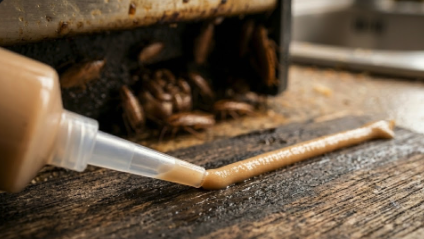
You bought the gel bait. You applied it behind the fridge, under the sink, along the cabinet hinges. You waited two weeks. The cockroaches came back — or never left.
This is not user error. It is a biological reality. The German Cockroach (Blattella germanica) is categorically different from every other pest species commonly found in Singapore homes. It has evolved, over thousands of years of close contact with human habitation, to be extraordinarily resistant to the exact interventions most homeowners reach for first. Understanding why requires understanding how this species actually behaves — and why the consumer pest control market is almost entirely unequipped to deal with it.
What Makes the German Cockroach Different From Every Other Species
It Lives Entirely Inside Your Home
The American Cockroach — the large reddish-brown species most people associate with drains and void decks — spends the majority of its life in the sewer system. It enters your property opportunistically through drain outlets and pipe gaps. Seal those entry points, and you significantly reduce the problem.
The German Cockroach has no such outdoor phase. It is a fully domestic species. It was born inside your home, it will reproduce inside your home, and the entire colony — from nymphs to egg-carrying females — lives within the structure of your kitchen cabinets, behind your refrigerator motor, inside your electrical switchboard, and within the gaps between your countertop tiles and wall surfaces.
There is no outdoor nest to treat. There is no entry point to seal. The colony is already inside.
Its Reproductive Rate is Exceptional
A single German Cockroach female can produce one egg capsule (ootheca) every few weeks, each containing 30 to 40 eggs. Under Singapore’s temperature and humidity conditions, nymphs reach reproductive maturity in as little as six weeks. A single mated female introduced into a new environment — say, inside a secondhand appliance, a grocery delivery box, or a neighbour’s moving carton — can establish a colony of several hundred within a single quarter.
This reproductive velocity is the reason why a German Cockroach infestation can feel like it explodes overnight. It does not. It scales quietly inside the harbouring sites until the population exceeds the space available, and only then does it become visibly obvious. By the time you see cockroaches in the open during daylight hours, you are not looking at a new infestation. You are looking at a mature, overcrowded colony.
It Harbours in Places You Cannot Reach
German Cockroaches do not live in the open. They aggregate in tight, warm, humid spaces with a physical contact surface on multiple sides — what entomologists call “thigmotactic” harbouring behaviour. In a residential kitchen, that means:
- Inside the motor housing of the refrigerator (warm, dark, vibration)
- Within the hinge channels of cabinet doors
- Behind the kickboard panel beneath the kitchen base cabinets
- Inside electrical switchboards and junction boxes
- Beneath the rubber seal of the dishwasher door
- Between the countertop edge and the wall tile grout
These are not locations you can reach with a spray can. They are not locations where a surface-applied gel bait will be encountered by the core of the colony.
Why DIY Gel Baits Fail
Placement Is Everything — and Consumer Placement Is Almost Always Wrong
Gel bait works on a specific principle: cockroaches forage outward from the harbouring site, consume the bait, return to the harbouring site, and die there — transferring the active compound to other colony members in the process. For this to work, the bait must be placed directly on or immediately adjacent to the active foraging trails between the harbouring site and the food source.
Consumer gel baits are almost always applied at the wrong locations. Homeowners place bait where they see cockroaches — on open shelf surfaces, along countertop edges, in the corners of open cabinets. These are transit zones, not harbouring sites. Foraging workers pass through them briefly. The bait is encountered inconsistently, the dosage transferred back to the colony is insufficient, and the reproductive core of the colony — the females carrying oothecae deep in the harbouring site — is never reached.
Bait Aversion: The Colony Learns to Avoid It
This is the factor that most homeowners do not know about, and it is the primary reason repeat DIY treatments produce diminishing results.
German Cockroach populations that have been repeatedly exposed to consumer gel baits develop a documented behavioural adaptation called bait aversion. The glucose compounds used as palatability enhancers in many consumer formulations trigger an aversive gustatory response in a subset of the population — meaning the cockroaches taste the bait, detect it as unpleasant, and avoid it. This trait is heritable. Within a few generations, a significant proportion of the colony will carry bait aversion, making the consumer product you are relying on functionally useless against your specific infestation.
Professional-grade gel baits rotate active ingredient combinations and palatability compounds across treatment visits specifically to counter this adaptation. Consumer products do not change formulation. The same product you bought six months ago has been training your cockroach population to ignore it.
Spraying Actively Worsens the Problem
If gel baiting is failing and the instinct is to supplement with a spray — stop.
Consumer-grade aerosols are repellent-based. Applied in the kitchen, they drive German Cockroaches away from the treated surface and deeper into the harbouring sites — or, more critically, through the shared wall cavities of an HDB flat into the adjacent unit. You have not reduced the colony. You have relocated part of it and made it harder to treat with gel bait, because the repellent residue on the surfaces now creates a chemical barrier that discourages cockroaches from foraging through the areas where your bait is placed.
Repellent spray and gel bait are mutually counterproductive when used together. Each one undermines the other.
What Professional Treatment Actually Does Differently
Step 1: Species Confirmation and Harbouring Site Mapping
Before any product is applied, Ezzy Pest Management’s NEA-certified technicians conduct a structured inspection to confirm the species present, locate the primary and secondary harbouring sites, and map the active foraging routes. This inspection uses targeted torchlight examination of known harbouring points, assessment of frass distribution patterns, and — where the infestation has spread to wall cavities — thermal imaging to detect heat signatures from colony aggregations behind surfaces.
Treatment without this information is guesswork. It is the inspection phase that makes professional intervention categorically different from consumer DIY.
Step 2: Professional-Grade Gel Bait at Mapped Harbouring Points
Our technicians apply professional-strength gel bait formulations directly at the harbouring sites identified during inspection — inside hinge channels, behind motor housings, within kickboard cavities, and at the precise foraging trail junctions where uptake will be maximised. The formulations we use are not available to the consumer market. They are calibrated for palatability to bait-averse populations and contain active compounds at concentrations that ensure sufficient dosage is transferred back to the harbouring core.
Step 3: Insect Growth Regulators
Alongside gel baiting, we apply Insect Growth Regulators (IGRs) — professional compounds that disrupt the German Cockroach reproductive cycle by preventing nymphs from developing into reproductive adults. IGRs do not kill cockroaches directly. They sterilise the next generation, breaking the population growth cycle that makes German Cockroach infestations so difficult to resolve with baiting alone. A treatment that kills the current adult population without interrupting reproduction will face a replacement population within six weeks.
Step 4: Structured Follow-Up
German Cockroach infestations — particularly established ones — often require more than one treatment visit to fully resolve, because eggs already in oothecae at the time of the first treatment will hatch after it. Our structured follow-up schedule ensures that hatching nymphs are intercepted before they reach reproductive maturity. Every Ezzy treatment is backed by our standard 2-month warranty.
For a complete overview of all cockroach species found in Singapore, the signs of an active infestation, and how Integrated Pest Management works across different property types, read our Ultimate Guide to Cockroach Control in Singapore.
The Longer You Wait, the Harder It Gets
German Cockroach infestations do not plateau. They scale. Every week of an established colony is another round of egg hatches, another generation of potentially bait-averse offspring, and another expansion of the harbouring network into new areas of your kitchen structure.
If the DIY options have failed — or if you want to avoid that cycle entirely — Ezzy Pest Management’s NEA-certified technicians are available 24 hours a day. Call our emergency helpline to schedule a site assessment. We will identify the species, map the harbouring sites, and apply the right treatment in the right locations from the first visit.
Ezzy Pest Management | NEA-Certified Pest Control Specialists | Serving HDBs, BTOs, Condos, Landed Properties & F&B Establishments Island-wide


