
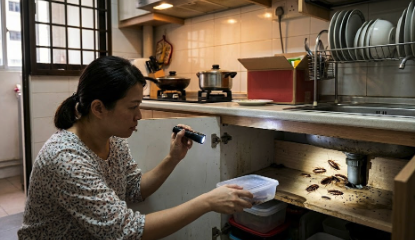
You cleaned the kitchen last night. The counters are spotless. The sink is dry. And yet this morning, a cockroach ran across the stovetop the moment you switched on the light.
If this sounds familiar, the problem is not your cleaning habits. The problem is that the cockroaches in your HDB kitchen are not living where you are cleaning. They are living in the structural gaps, motor cavities, and sealed-off spaces that no sponge or spray can reach — and they only venture out when the lights go off and the flat falls quiet.
Knowing exactly where to look is the first step toward understanding the scale of what you are dealing with. This guide covers the specific harbouring locations most commonly found in HDB kitchens, why each one is attractive to cockroaches, and how to conduct a methodical self-inspection before calling in a professional.
Why HDB Kitchens Are Particularly High-Risk
HDB flats — especially resale units and older blocks — have a set of structural characteristics that make the kitchen a near-perfect cockroach environment regardless of how clean the occupants are.
Shared drainage infrastructure. Every HDB block connects its units to a common drainage and sewage network. The floor trap beneath your kitchen sink, the pipe penetrations behind your washing machine connection point, and the service riser running through or adjacent to your kitchen wall all link your unit directly to a building-wide drain system that American Cockroaches actively inhabit. Even if the German Cockroach infestation inside your kitchen originated from a neighbouring unit or a delivered grocery box, the building’s drain network provides a constant secondary pressure of American Cockroaches looking for entry points.
Shared wall cavities with adjacent units. HDB kitchen walls — particularly those shared with the neighbouring unit or with the wet kitchen — contain cavities that cockroaches exploit as travel corridors. A German Cockroach colony established in your neighbour’s kitchen can migrate into yours through gaps around shared pipe penetrations, electrical conduit entries, and the service riser access panel. This is why HDB infestations frequently recur even after effective treatment in a single unit.
Older plumbing and fitout gaps. In resale HDB flats, years of plumbing repairs, renovation works, and fitting replacements often leave minor gaps around pipe penetrations, loose skirting boards, and poorly sealed cabinet-to-wall junctions. Each of these is a harbouring opportunity and a travel route that cockroaches will exploit.
The 10 HDB Kitchen Harbouring Spots You Need to Check
1. Inside the Refrigerator Motor Housing
Pull your refrigerator away from the wall. Look at the rear lower panel — the grille covering the compressor and motor. This area generates consistent warmth, operates continuously, and is almost never cleaned. It is the single most common German Cockroach harbouring site in any Singapore kitchen.
Use a torch to look through the grille slats. You are looking for dark specks of frass, shed exoskeletons, or the egg-shaped outline of an ootheca. Live cockroaches will scatter immediately when the light hits them.
2. Beneath the Refrigerator Drip Tray
Most refrigerators have a drip tray positioned beneath the compressor that collects condensation. In many households this tray is never emptied or cleaned. A combination of standing water, food residue carried in on the cockroaches’ bodies, and consistent warmth makes this an ideal secondary harbouring site. Slide the tray out and inspect it.
3. Inside Cabinet Door Hinge Channels
Open every cabinet door in your kitchen and examine the hinges closely with a torch. The recessed channel inside a standard concealed hinge is exactly the right width for a German Cockroach to wedge itself into — dark, with physical contact on all sides. Frass accumulation inside hinge channels is a reliable early indicator of an active infestation even before you see live cockroaches.
4. Behind the Kickboard Panels
The kickboard — the vertical panel running along the base of your kitchen cabinets at floor level — conceals a cavity between the cabinet carcass and the floor. This space is dark, undisturbed, and often connected along the full run of the kitchen. It is a primary harbouring and travel route for both German and American Cockroaches. Remove the kickboard panels (they typically clip or slot out without tools) and inspect the cavity behind them with a torch.
5. Under the Kitchen Sink, Around the Pipe Penetrations
The cabinet beneath the kitchen sink is one of the most cockroach-prone spaces in any HDB flat. It combines three attractants: moisture from pipe connections and occasional drips, darkness, and a direct connection to the building’s drain network through the pipe penetrations in the cabinet floor and back panel. Inspect the gap around every pipe where it exits through the cabinet surface. Any gap larger than 6mm is a viable cockroach entry and harbouring point.
6. Behind the Stove and Between the Stove and Cabinet
The gap between a freestanding stove and the adjacent cabinet, and the space beneath a built-in hob between the countertop and the cabinet below, are consistently warm from cooking heat and accumulate grease and food debris that cleans only with deliberate effort. Pull the stove forward and inspect the wall and floor behind it. Check the underside of a built-in hob frame by shining a torch through the drawer space below.
7. Inside the Rangehood Filter and Motor Housing
The rangehood above your stove accumulates grease at a rate that makes it one of the richest food sources in the kitchen for cockroaches. The filter panels, the interior housing walls, and the motor cavity at the top of the unit all warrant inspection. Grease deposits combined with the residual warmth of the motor make this an attractive secondary harbouring site, particularly for German Cockroaches that have already established a primary colony behind the refrigerator or inside the cabinet hinges.
8. Inside Electrical Points and Junction Boxes
The electrical sockets, switch plates, and junction boxes on your kitchen walls contain small but usable cavities behind the faceplate. In older HDB units where the wiring runs through the wall cavity rather than surface conduit, these cavities connect to the broader wall space — giving cockroaches both a harbouring point and a travel corridor. Inspect the gap between the faceplate edge and the wall plaster. Frass along this joint line is a reliable sign of activity.
9. Behind and Beneath the Washing Machine (If Kitchen-Located)
Many HDB units position the washing machine in or adjacent to the kitchen. The drainage hose connection point, the pipe penetration at the back of the machine, and the floor space beneath it combine the same risk factors as the under-sink cabinet — moisture, darkness, and direct connection to the building’s drainage network. Pull the machine forward and inspect the wall and floor behind it.
10. Inside Stored Cardboard Boxes and Grocery Packaging
This is the most common introduction route for German Cockroaches into a previously clean kitchen. Cockroaches and their eggs are regularly transported inside cardboard packaging from supermarkets, wholesale suppliers, and food delivery boxes. A single ootheca concealed in the fold of a cardboard box, placed in your kitchen storeroom or cabinet for a week, is sufficient to introduce a viable colony. Avoid storing cardboard boxes in the kitchen long-term, and inspect bulk grocery deliveries before storing.
How to Conduct Your Own Inspection
A methodical self-inspection takes about 20 minutes and will tell you whether you are dealing with an early or established infestation. You need a torch and, ideally, a second person to move appliances.
Work through the 10 locations above in order. At each location, you are looking for four things:
- Live cockroaches — they will scatter immediately when the light hits
- Frass — dark pellets or specks, ranging from ground-pepper-sized (German Cockroach) to rice-grain-sized (American Cockroach)
- Oothecae — dark brown, oval capsules approximately 6-8mm long, often wedged into joints or crevices
- Shed exoskeletons — translucent hollow shells in the cockroach shape, indicating multiple developmental cycles have occurred
If you find frass or oothecae in two or more of the above locations, the infestation is established and multi-site. DIY gel bait applied at this stage is unlikely to resolve it — the colony is too dispersed and the core harbouring sites are not accessible to consumer-grade products.
For a full explanation of why consumer gel baits consistently fail against established German Cockroach colonies — and what professional-grade treatment does differently — read our dedicated guide: Why German Cockroaches Are the Hardest to Eliminate — And Why DIY Gel Baits Fail.
For a broader overview of all cockroach species in Singapore and how professional Integrated Pest Management works, read our Ultimate Guide to Cockroach Control in Singapore.
What to Do After Your Inspection
If you found frass or oothecae in one location only — the infestation may still be early-stage. This is the window where professional intervention is fastest and least expensive. Call Ezzy Pest Management to schedule a site assessment before the colony expands.
If you found activity in two or more locations — the infestation is established. Do not apply consumer aerosol spray — it will scatter the colony into additional harbouring sites and significantly complicate professional treatment. Call our 24-hour helpline directly.
If you found American Cockroach activity at drain or pipe penetration points — the priority is sealing those entry points with appropriate waterproof compound, followed by a professional residual treatment at the drain surrounds. Our technicians will advise on both at the site assessment.
Ezzy Pest Management’s NEA-certified technicians serve HDB flats across Singapore. Our inspection-first approach means we locate every harbouring site before applying any treatment — so the first visit produces results, not guesswork. Every treatment is backed by our standard 2-month warranty.
Call our 24-hour emergency helpline to schedule an assessment today.
Ezzy Pest Management | NEA-Certified Pest Control Specialists | Serving HDBs, BTOs, Condos, Landed Properties & F&B Establishments Island-wide


